












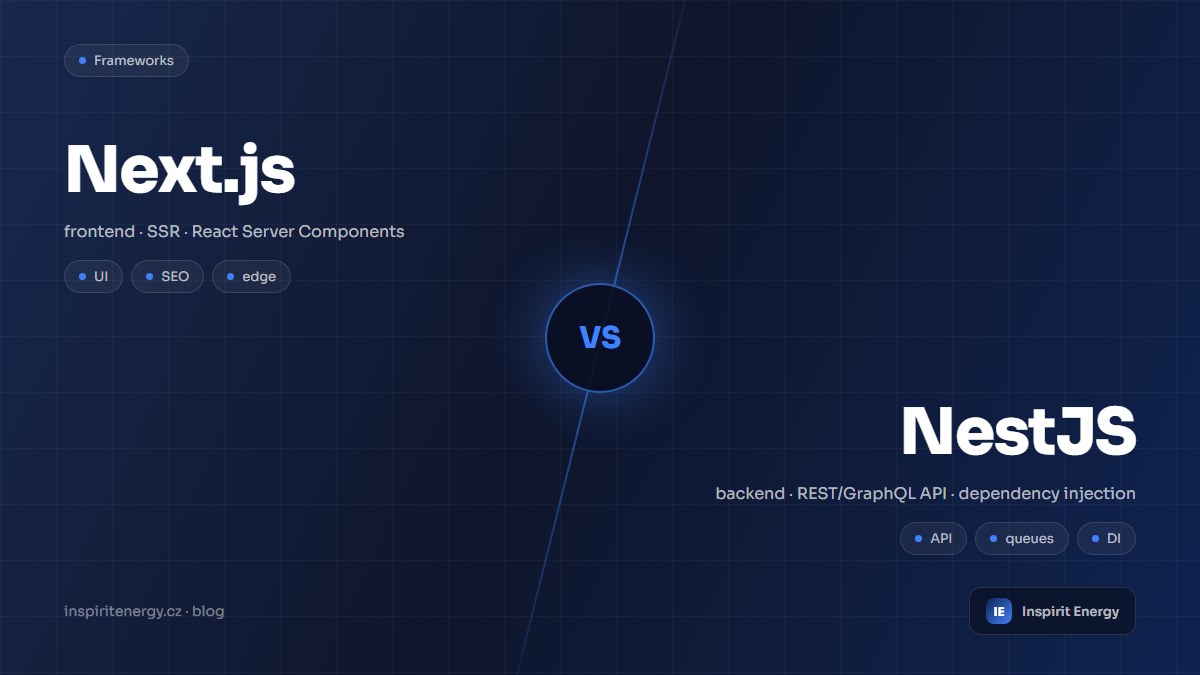
Next.js and Nest.js — two popular frameworks with almost identical names but entirely different purposes. Next.js is a React framework for frontend and full-stack web applications, while Nest.js is a Node.js backend framework for building scalable server-side applications.
In this article we break down the key differences between the two technologies, highlight their respective strengths, and help you decide which framework is the right fit for your project.
Choosing the right framework is one of the most important decisions at the start of a project. The wrong choice can lead to technical debt and increased costs down the road.
Next.js excels at server-side rendering (SSR), static site generation (SSG), and delivers an outstanding developer experience thanks to hot reloading and automatic routing. It is ideal for websites, e-commerce stores, and SaaS applications where SEO and load speed matter.
When to choose which framework?
Nest.js, on the other hand, is designed for complex backend systems. It uses TypeScript, supports dependency injection, and follows a modular architecture inspired by Angular. It is ideal for microservices, REST and GraphQL APIs, real-time applications, and enterprise backends.
- Next.js for frontend and full-stack applications with a focus on SEO and performance
- Nest.js for robust backend APIs and microservice architectures
- Both frameworks can be combined — a Next.js frontend with a Nest.js backend
- TypeScript is native to both frameworks
- The choice depends on the nature of the project and the team's experience
Both frameworks have their place in modern development. For most web projects we recommend Next.js on the frontend and Nest.js on the backend — this combination delivers the best performance, scalability, and developer experience.